
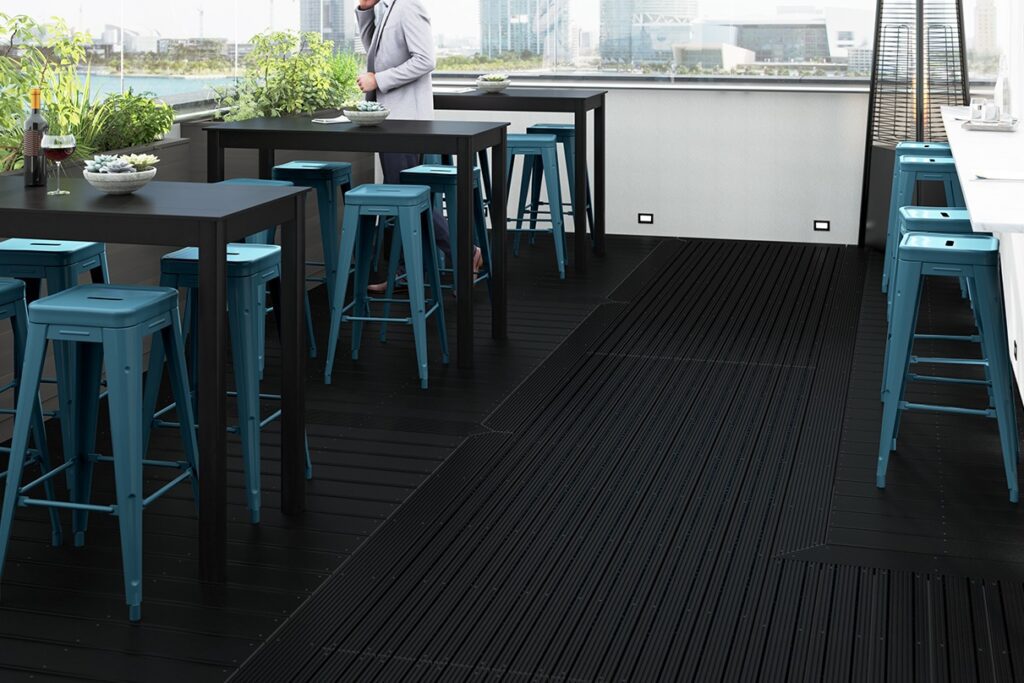
When specifying commercial composite decking for public realm, educational or hospitality schemes, board profile and composition play an important role in long-term performance. Hotel terraces, school courtyards, public boardwalks and housing podiums all face demanding conditions, from constant footfall and spilt drinks to heavy furniture and the British weather. The right specification helps support long-term performance and reduce the risk of remedial work.
Here’s what to look for in commercial composite decking, from the team who make it.
Domestic vs Commercial Composite Decking Boards
Most composite decking sold for UK homes uses lightweight, hollow boards. They may be suitable for domestic settings, but under constant commercial footfall, hollow chambers can flex, crack at the edges and sag between joists. Check the warranty too, as many domestic boards aren’t covered for commercial use.
Commercial applications need a solid core profile. It spreads point loads from tables, planters and dining pods, and it holds its shape for much longer. Our commercial solid core profiles are 25mm deep, designed for high traffic areas like shopping centre seating, hospitality terraces and event spaces.
Slip Resistance in Commercial Outdoor Spaces
Grip is measured with the pendulum test, set out in BS 7976-2. It gives a Pendulum Test Value (PTV), and the higher the number, the better the grip. In the UK, a PTV of 36 or above is classed as low slip potential. Between 25 and 35 is moderate, and anything below 25 is high risk.
For public spaces, the wet result is the metric that matters. Under UK Health and Safety Executive (HSE) guidelines, surfaces subject to public footfall must demonstrate a wet Pendulum Test Value (PTV) of 36 or above (tested to BS 7976-2 or BS EN 16165) across the direction of pedestrian flow to be categorised as having low slip potential. Ask for independent test certificates verified across the exact board finish specified. In high-risk transition zones, such as disabled access ramps, public building entrances, and pool surrounds, incorporating anti slip composite decking with dedicated high-grip inserts provides maximum slip mitigation.
Low Maintenance in High Traffic Areas
Traditional timber decking needs sanding, staining and sealing to maintain it, and it can still rot, splinter and warp. Composite boards can reduce the maintenance associated with timber. They’re also designed not to splinter, which can be beneficial around pools, play areas and anywhere people walk barefoot.
Capped boards go a step further. Their tough outer shell gives enhanced protection against UV fading and food and drink spills, which makes a real difference on hotel and restaurant terraces. Day-to-day, it’s occasional cleaning with water and a mild detergent.
Best Practices for Commercial Composite Deck Construction
A commercial decking board is only as reliable as the substructure supporting it. For commercial composite deck construction, subframe design must account for dynamic pedestrian loads and drainage:
- Optimise Joist Centres: Follow manufacturer load span tables, reducing joist centres from the standard 400mm down to 300mm in areas with heavy dynamic traffic or high point loads.
- Durable Substructures: Use composite or aluminium joists, which match the 25+ year lifespan of the deck boards and prevent the rotting associated with treated timber.
- Adjustable Pedestals: On roof terraces, podiums, and balconies, install adjustable pedestals to achieve precise drainage falls without puncturing waterproofing membranes.
- Thermal Expansion Allowances: Allow calculated expansion gaps at board ends and perimeters to accommodate seasonal temperature changes.
A Long-Term Investment for Commercial Outdoor Projects
Composite costs more upfront than traditional timber. Over 25 years, the overall costs can compare differently. Composite decking can reduce the need for regular treatment, replacement boards and repairs. For operators, that can mean fewer areas taped off in peak season. For contractors, it can mean fewer callbacks.
Our composite decking boards come with a 25-year performance warranty for commercial use. They’re made in the UK from 95% recycled materials, which can help you meet the sustainability targets that many commercial tenders now ask for. We can also cut boards to any length between 1.5m and 6m, so you’re not left with offcuts to throw away or extra joins across the deck.
Partner with UK Composite Decking Trade Suppliers
Specifying outdoor flooring for an active commercial scheme? As leading British composite decking trade suppliers, Ecodek provides full technical project support, including span calculations, load test data, and physical trade sample packs.
Explore our full range of trade composite decking and commercial systems, or contact our technical team to review your scheme drawings.
Frequently Asked Questions
What’s the difference between domestic and commercial composite decking?
Domestic boards are usually lighter and often hollow, designed for garden use. Commercial composite decking boards have a solid core and more depth, helping them manage constant footfall, heavy furniture and point loads. They should also carry a warranty that covers commercial use.
What pendulum slip rating is needed for commercial composite decking in the UK?
There’s no single legal figure, but a Pendulum Test Value (PTV) of 36 or above is the accepted benchmark for low slip potential in public areas. Always check the wet result, tested to BS 7976-2 on the board profile you’re specifying.
Can composite decking boards take heavy items like large planters, outdoor bars and heaters?
Yes, with solid core boards and the right substructure. Heavy items press a lot of weight into a small area of the deck, so they usually need the joists (the supporting beams underneath) spaced closer together, or extra support where the item will sit. Share the expected weights with the manufacturer at the design stage so the frame can be planned around them.
What substructure is recommended for commercial composite decking projects?
For commercial projects, composite decking joists and subframes or aluminium joists can be suitable options, as they’re low maintenance and won’t rot or warp like timber. For outdoor living spaces like roof terraces, adjustable pedestals level the deck over the membrane without damaging it. Always follow the manufacturer’s joist centres for the board you’ve chosen.
Are solid composite boards better than capped hollow boards in high-traffic areas?
For strength, yes. Solid boards can offer greater resistance to impact, edge damage and sagging under heavy use. Capping improves resistance to stains and fading, so a solid board with a suitable surface finish can be a good choice for busy commercial outdoor spaces.