
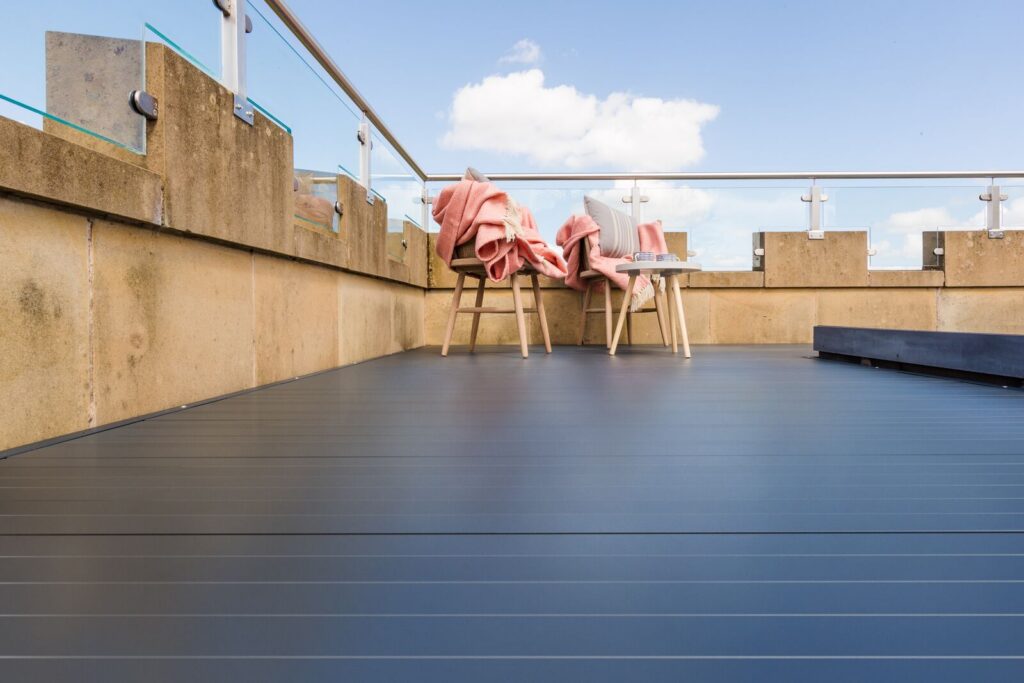
Looking to replace a timber deck with aluminium boards? You’re in the right place. Whether you’re an installer doing this retrofit for the first time or a savvy DIYer giving your garden an upgrade, we’ve rounded up everything you need to know to start the transformation on the right foot.
Why retrofit timber decking with aluminium boards?
There are a number of reasons why aluminium is one of the most popular materials for upgrading decked areas, whether for a commercial application or at home.
1. Longevity
Aluminium boards have a longer lifespan than timber. The boards don’t splinter, warp, or rot, even in tough weather conditions. They’re also resistant to insect damage, so they won’t decay over time.
2. Low-maintenance
Timber is more challenging to care for and maintain – it requires regular treatment such as sanding, staining, painting, and sealing. On the other hand, aluminium needs only a sweep and a rinse with water to remove dirt and debris and stay in tip-top condition all year-round.
3. Fire resistance
When prioritising fire safety, aluminium boards are the clear choice due to their fire-resistant properties. Some boards, like those in our Adek system, are also A2fl-s1 and A2-s1,d0 fire-rated (two Euroclass fire ratings under BS EN 13501-1) and fully compliant with the latest building regulations. They’re ideal for fire-prone areas, as well as the roof terraces and balconies of high-rise buildings, where strict fire safety regulations must be met.
For the full advantages of the material, please head to our aluminium decking page.
Subframes
When it comes to fitting the deck, the subframe is one of the biggest elements to consider. While it’s possible to remove the timber boards but keep the original subframe and fit the new aluminium boards over the top, the timber subframe is still vulnerable to:
- Rotting
- Warping
- Splintering
To ensure a fire-compliant system, you must replace the subframe with an aluminium system. However, if fire compliance is not a requirement and your existing timber subframe is in good condition, you can continue with a retrofit.
If you’d like to experience the full benefits of the aluminium boards and have the scope to do so (in terms of time, investment, and space), we recommend replacing the subframe with an aluminium system. However, as long as the existing subframe is in good condition, you can continue with a retrofit.
Considerations for retrofitting an aluminium deck on a timber subframe
- Check the condition of the subframe: First things first, you need to make sure the current joists are in excellent condition. If they are showing signs of wear and tear or general decay, you risk installing your aluminium boards on a foundation that’s likely to fail later down the line.
- Look for sealed or channelled board designs: These will prevent water from dripping through any gaps in the deck, which could cause the timber joists to rot and warp.
- Consider joist spacing: Did you know that timber joists tend to be spaced at wider centres than what’s recommended for aluminium boards? It’s likely you’ll need to install extra timber joists to meet the maximum span requirements of the boards. While these vary depending on the specific board type, it can be up to a maximum of 1200mm centre-to-centre. Always refer to the manufacturer’s technical datasheets for this information.
- Risk of corrosion: In some cases, contact between aluminium and other metals (such as some timber treatments and steel fixings) can cause corrosion. To reduce the risk of this happening and the system failing, you’ll need to purchase ‘isolating’ materials. For example, separating pads to sit between the two metals and prevent any corrosion.
Advantages of installing an aluminium subframe
- Durability: Like the boards, the components within an aluminium subframe all have longer lifespans than traditional fixings for timber. They’re resistant to the elements, supporting a deck that has longevity at its core.
- A contemporary finish: If aesthetics are important to you, then an aluminium subframe is the way forward. Our complete Adek system is available in shades of grey, from the joists and beams to screws and clips. When the boards match the subframe, the overall finish is both modern and sleek.
- Sustainability: Given that aluminium is a 100% recyclable material, the full decking system can be repurposed and reused when it reaches end of life, reducing the environmental impacts associated with timber (e.g. deforestation). We make Adek boards from 100% recycled aluminium, helping to limit the demand on virgin materials.
- Fire-resistance: For absolute confidence in the fire safety of the deck system, an aluminium subframe is the only option. At Ecodek, all the components we supply are non-combustable, so you can have confidence in the fire-resistance of the complete deck.
The biggest challenges of a retrofit
Like any retrofit deck project, you will come across a few challenges. While the fitting of aluminium deck systems is straightforward, it’s important to make time to:
- Prepare the area
Make sure you take the necessary safety precautions to remove the old timber boards. For instance, wear heavy-duty gloves and safety goggles in case the boards split or splinter.
- Move the boards from A to B
Ensure you have the right amount of access to move the old boards away from the deck and the new aluminium boards into the area, with enough space for your tools and preparation.
Tool list for an aluminium deck retrofit
The standard tools you’d usually use to fit timber or composite boards are all you need to fit the aluminium system. Make sure you’ve got the correct blades fitted to any drills or circular saws. For instance, a carbide-tipped circular saw blade is best for non-ferrous materials that have a high tooth count to ensure the smoothest cuts.
You’ll find all the tools you need to complete the job in the list below:
- Circular saw or mitre saw with a suitable blade
- Spirit level
- Cordless drill
- PPE – gloves, ear defenders, a dust mask, and gloves
A guide to retrofit aluminium boards on an existing subframe
And now for the fun part, the installation itself. We’ve outlined the stages of the retrofit below, but for more details or advice, please get in touch with our friendly team.
- Remove existing boards and dispose of them correctly.
- Review the current subframe. Do any of the joists or posts show signs of decay? If so, replace these before anything else and add any necessary additional joists to achieve the right spacing for the new boards.
- Give the subframe a clean and add the isolation materials to the top of all the timber joists where fasteners will be used.
- Check the subframe’s drainage slope. Use a spirit level to check that it’s level across its width and length.
- You’re now ready to install the first board, place the first board in place and fix into the channels with the correct screw. Keep the right size expansion gap (usually around 5mm, but always check the installation guide) between the board ends and any permanent structure or wall.
- Fix the next board, making sure to maintain a 5mm expansion gap between parallel boards.
- Repeat steps 6 and 7 until you get to the last board.
- To secure the final board, slide it into the clips and face-fix the open side to the structure (for example, a wall). Allow for expansion by pre-drilling holes that are a little wider than the screws before screwing the board into the joist underneath.
Finishing touches
The deck is installed, but the process isn’t over just yet. For the most professional finish, remove any burrs from cut ends with sandpaper or a file. And for any exposed edges, use skirting trims or fascia boards to achieve a clean and complete look. There you have it, your guide to retrofitting aluminium boards over a traditional timber subframe. Please contact us for additional information or support specific to your project.